The Emotional Side of Sports Injury: Rebuilding Confidence When You Doubt Your Return
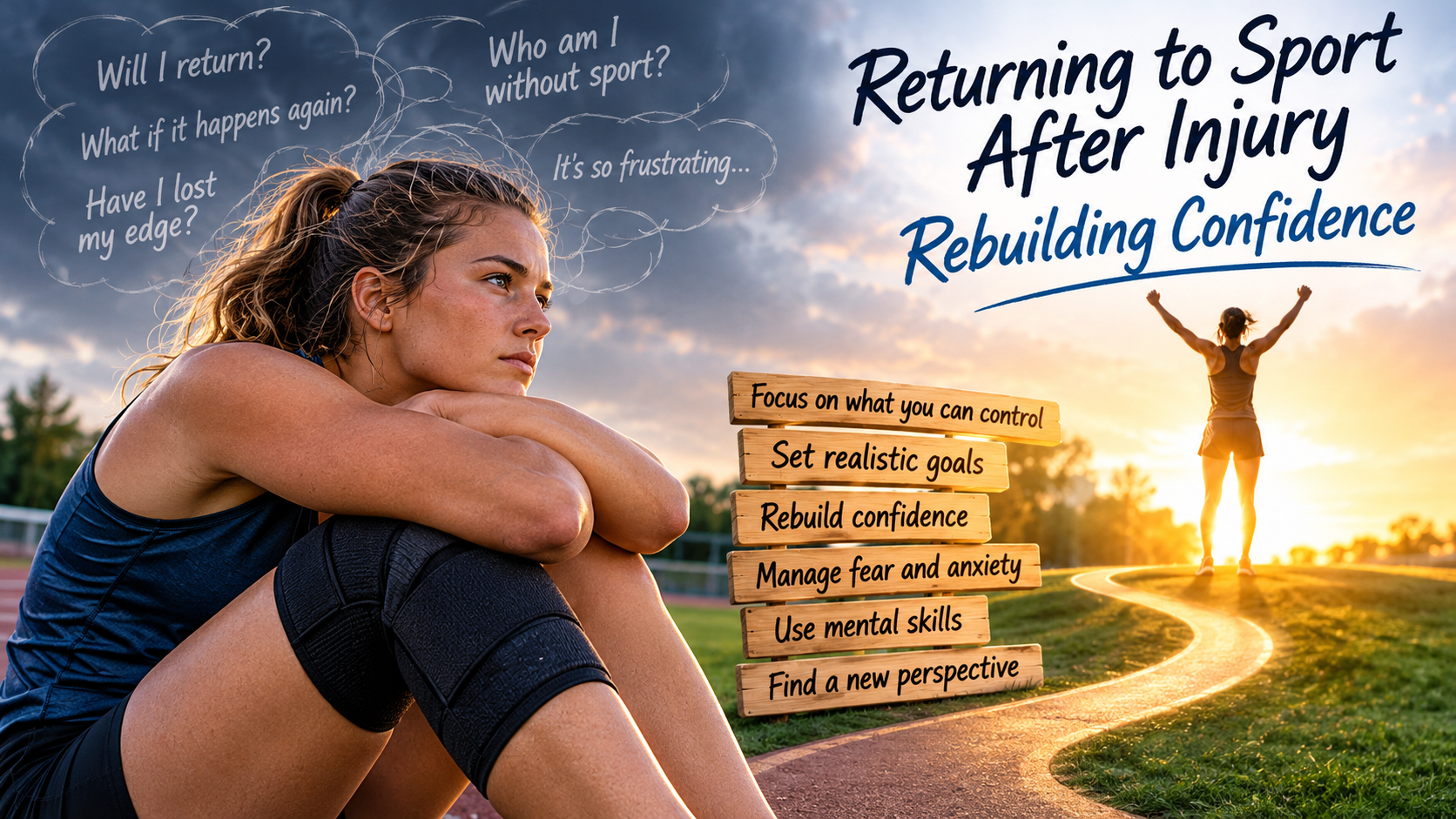
An injury affects far more than an athlete's body. It can challenge their confidence, identity, emotional stability and belief in what is possible. Learning to recover mentally as well as physically can make a significant difference to the journey back to sport.
Every athlete understands the importance of physical preparation. We train our bodies, refine our technique, build strength and endurance, and work towards becoming the best athletes we can be.
But what happens when an injury suddenly brings that process to a halt?
One moment, you are training, competing and working towards your goals. The next, you may find yourself sitting on the sidelines, watching teammates continue without you, wondering when you will return and whether you will ever feel quite the same again.
The physical injury may be obvious. The emotional consequences are often much less visible.
As someone who has spent decades working with hypnosis and helping athletes develop their mental performance, I understand how closely the mind and body are connected. But my understanding of injury is not based solely on my professional work. I have experienced the physical pain, frustration and profound changes that injury can bring to an athlete's life.
My own journey has taught me that recovery is not always simply a matter of getting back to where you were. Sometimes, it means learning to live with unexpected limitations, reconsidering who you are and finding a new way forward.
These are experiences that have shaped both my personal perspective and the way I work with athletes today.
The emotional impact of an injury
An athlete's response to injury is rarely just about pain or the time required for physical healing. Sport often becomes an important part of how we see ourselves. It provides structure, purpose, social connection, achievement and a way of measuring progress.
When injury removes those things, even temporarily, the emotional consequences can be considerable.
1. Losing a part of your identity
For many athletes, sport is more than something they do. It is part of who they are.
They may identify as a gymnast, rugby player, swimmer, golfer or runner long before they think of themselves in any other way. Their daily routines, friendships, ambitions and sense of accomplishment may all revolve around their sport.
When an injury prevents them from participating, they can experience a genuine sense of loss.
They may ask themselves:
Who am I if I cannot compete?
What happens if I cannot return to my previous level?
Will I lose my place on the team?
Will my coach still believe in me?
What if other athletes move ahead while I stand still?
These questions can create considerable emotional pressure, particularly for athletes who have invested years of effort in developing their skills.
I understand this personally. Rugby was an important part of my life, and although it brought its fair share of knocks and bruises, one particular injury changed things considerably. A high tackle ruptured my sternocleidomastoid muscle in my neck, leaving me wearing a neck brace for more than a year.
For an athlete accustomed to physical activity, having to live with such a restriction can be difficult to accept. It affects more than what you can physically do. It changes your routine, your independence and the way you relate to an important part of your life.
Many years later, I experienced another injury while training to swim the English Channel. I was in the middle of a six-mile ocean swim off San Diego when I felt pain in my groin. The problem turned out to be an inguinal hernia. What followed was a much longer and more complicated journey than I could have anticipated, involving three surgeries to try to remove migrated mesh. The complications caused nerve damage and persistent pain.
Both experiences profoundly affected my lifestyle and, perhaps more significantly, my sense of identity.
When sport has been central to your life, losing the ability to do what you love can leave you questioning who you are without it. You can find yourself grieving not only for the activities you have lost, but also for the future you imagined.
I had to find a new way forward and, in many respects, reinvent myself. That process was possible, but it required considerable mental reframing, adjustment and rediscovery.
I share this because I want athletes to understand something important: if an injury leaves you questioning who you are, you are not weak, and you are not alone. You are dealing with a genuine emotional challenge.
Your sporting identity matters, but it does not represent the entirety of who you are. Even when injury changes what is physically possible, your experience, character, knowledge and capacity for growth remain part of you.
Recognising that distinction can be an important first step towards moving forward.
2. Frustration, anger and impatience
Athletes are accustomed to working towards improvement. If something needs to change, they train, practise and work harder.
Injury can challenge that familiar approach.
Recovery does not always follow a straight line. There may be encouraging progress one week, followed by soreness, restricted movement or a setback the next. An athlete who is used to taking control through effort may find it particularly frustrating to discover that pushing harder is not necessarily the answer.
This can lead to impatience, irritability and disappointment.
The temptation is to measure recovery against an imagined timetable rather than the body's actual progress.
I know how difficult it can be when your physical circumstances impose limitations that your mind is not yet ready to accept. You may still feel the same desire to train, compete and challenge yourself, but your body may no longer respond in the way you expect.
That gap between what you want to do and what you can currently do can be emotionally exhausting.
But healing is not a competition, and trying to prove that you are ready before you are physically prepared can create unnecessary risk.
The objective is not to return as quickly as possible. It is to return when you are ready to perform safely and confidently.
That requires a different kind of discipline: learning when to push forward, when to adapt and when to allow recovery to take its course.
For some athletes, it also means accepting that the outcome may be different from what they originally hoped. That can be painful, but acknowledging reality gives you a starting point from which to make constructive decisions.
3. Fear of reinjury
One of the most challenging aspects of returning to sport is discovering that physical recovery and psychological readiness do not always happen at the same pace.
An athlete may have completed rehabilitation, regained strength and received medical clearance to return. Yet when they approach the movement associated with their original injury, something changes.
They hesitate.
A gymnast may feel apprehensive about a skill they once performed automatically. A rugby player may instinctively protect themselves before contact. A runner may become anxious when increasing speed. A golfer may become unusually conscious of a movement that previously felt natural.
The athlete might think, What if it happens again?
That question can quickly become a cycle of anticipation, tension and self-monitoring.
The athlete starts watching every movement, looking for signs that something might go wrong. Instead of allowing a well-practised skill to unfold naturally, they begin consciously controlling parts of the performance that previously happened automatically.
This can interfere with timing, fluidity, concentration and confidence.
It is important to understand that fear following injury is not necessarily irrational. It may be the mind's attempt to protect the athlete from experiencing the same pain or disruption again.
The challenge is to help the athlete recognise the protective response without allowing it to dictate every decision.
For an athlete returning from injury, this means rebuilding trust progressively, in partnership with their rehabilitation team. The aim is not to ignore legitimate warning signs or pretend that nothing happened. It is to develop confidence that is consistent with their physical readiness and experience.
4. Doubting your ability to return
Sometimes the greatest difficulty is not fear of pain but uncertainty about performance.
An athlete may wonder whether they will regain their former speed, strength, coordination or competitive edge. They may compare themselves with their pre-injury performance and feel disappointed by the difference.
They might think:
I used to be better than this.
Why does this feel so difficult now?
What if I never get back to where I was?
These thoughts can become particularly discouraging when progress feels slow.
But recovery is not simply a matter of returning to an earlier version of yourself. It involves learning to trust your body again, adapting to what it can currently do and rebuilding your capabilities progressively.
For some athletes, the eventual challenge is even greater: they discover that they cannot return to their previous activity in the way they had hoped.
This is a difficult reality to confront. It may require grieving the loss of a goal, adjusting expectations or finding a different way to participate in sport and physical activity.
My own experiences have taught me that moving forward sometimes requires a fundamental change in perspective. You may not be able to control every consequence of an injury, but you can gradually develop a different relationship with those consequences.
You do not have to prove that you are the athlete you were before the injury at every training session.
You need to give yourself the opportunity to become the person and athlete you are capable of being now.
The pressure athletes place on themselves
Athletes are often highly motivated, competitive and accustomed to high expectations. These qualities can be powerful advantages, but they can also make injury more difficult to manage emotionally.
Some athletes feel guilty about resting. Others believe they should be doing more, recovering faster or showing everyone that they are still mentally tough.
There may also be external pressure from coaches, teammates, parents, sponsors or selection deadlines.
When an athlete feels that their value depends on their performance, an injury can threaten more than their sporting ambitions. It can affect their self-worth.
This is where the emotional side of recovery deserves particular attention.
The athlete needs to understand that a temporary reduction in performance does not mean a reduction in personal value.
Rest, rehabilitation and patience are not signs of giving up. They are part of the process of returning to performance.
And if returning to the same level is no longer possible, the athlete may need support in finding meaning and fulfilment beyond their previous performance expectations.
I have had to work through aspects of this myself. Reinventing yourself after an injury is not something that necessarily happens overnight. It can involve a lengthy period of reassessment, emotional adjustment and learning to see possibilities where previously there seemed to be only limitations.
That process requires patience with yourself, just as physical rehabilitation requires patience with your body.
Rebuilding confidence during recovery
So, how can an injured athlete begin to manage the emotional challenges of recovery?
There is no single approach that works for everyone, but several strategies can make the process more manageable.
1. Focus on what you can control
An injury often creates uncertainty. You cannot always control how quickly tissues heal, when discomfort will settle or exactly when you will return to competition.
Trying to control these uncertainties can become exhausting.
Instead, identify the things you can influence.
You can follow your rehabilitation plan, communicate honestly with your medical team, maintain good recovery habits, practise appropriate mental skills and focus on the next achievable step.
You can also control how you interpret a difficult day.
Rather than thinking, I am not making progress, ask yourself, What can I learn from today, and what is the next appropriate step?
This shift moves your attention away from an uncertain future and towards constructive action in the present.
Progress does not always mean doing more. Sometimes it means moving better, managing a movement with less apprehension or learning to recognise when your body needs additional recovery.
In my own experience, accepting what I could no longer control was an important part of finding a way forward. That did not mean giving up on myself. It meant redirecting my energy towards the choices and opportunities that remained available.
2. Set smaller, meaningful goals
Athletes are naturally inclined to think about major objectives: returning to competition, winning a place on the team, achieving a personal best or regaining a previous level of performance.
These goals matter, but they can feel overwhelming when the return is still some distance away.
Break the process into smaller, realistic steps agreed with your rehabilitation team.
Depending on the injury and stage of recovery, these might include completing a prescribed exercise programme, improving a specific movement, regaining a particular level of strength or gradually reintroducing a sport-specific skill.
Each appropriate step provides an opportunity to recognise progress.
The important point is to measure success against the current stage of recovery rather than against your ultimate competitive goal.
You are not failing because you cannot yet do everything you could do before the injury.
You are working through a process, and each suitable step contributes to that process.
3. Rebuild trust in your body gradually
Confidence is not always restored by telling yourself to be confident.
It is more likely to develop through experiences that demonstrate, within appropriate physical limits, that you can perform a movement safely and effectively.
This is why a gradual, professionally guided return to activity can be so important.
Begin with the level of activity recommended by your medical or rehabilitation team. Build complexity, intensity and sport-specific demands as appropriate, rather than jumping straight to the most challenging version of the skill.
Allow yourself to experience success at each stage.
If apprehension appears, acknowledge it without treating it as proof that something is wrong. Equally, do not ignore pain, new symptoms or medical advice simply to overcome fear.
The purpose is to distinguish understandable emotional caution from genuine physical warning signs, with suitable professional guidance.
Confidence grows when physical readiness, repeated experience and a sense of control begin to come together.
4. Change the way you speak to yourself
The language athletes use internally can influence how they experience recovery.
Consider the difference between these two statements:
I am so far behind. I will never get back to my old level.
And:
I am recovering. I do not need to be at my previous level today. I need to work on the next step.
The first statement focuses on comparison, uncertainty and a feared outcome. The second acknowledges the present situation while keeping attention on something constructive.
Positive self-talk does not mean pretending that everything is fine or denying legitimate concerns. It means choosing a more balanced and useful response to those concerns.
When negative thoughts arise, ask yourself:
Is this a fact, or is it a prediction about the future?
What evidence do I have about my current progress?
What would I say to another athlete in the same situation?
What is the most useful thing I can do next?
You do not need to eliminate every doubt before you can move forward. You can learn to respond to doubt without automatically believing everything it tells you.
5. Use mental rehearsal appropriately
One of the approaches I value in sports performance work is mental rehearsal.
Athletes routinely use physical practice to develop skill. Mental rehearsal can complement that process by allowing them to engage with a movement, performance routine or competitive situation in their mind.
During injury recovery, this may offer a way to maintain a psychological connection with the sport when full physical participation is not possible.
For example, an athlete might mentally rehearse preparing for competition, following their pre-performance routine, maintaining composure or carrying out a familiar skill with a sense of rhythm and control.
The emphasis should be on the process of performing rather than on forcing a particular outcome.
An athlete might imagine approaching a movement calmly, maintaining their usual cues and allowing a well-practised sequence to unfold. They can also rehearse responding constructively to nerves, distractions or unexpected changes.
Mental rehearsal should be adapted to the individual. Some athletes find visual imagery natural, while others respond more readily to bodily sensations, sounds, verbal cues or the emotional feeling associated with performing well.
It is not necessary for everyone to create vivid mental pictures.
For athletes who are apprehensive about returning, imagery can be introduced gradually and should complement, rather than replace, physical rehabilitation and appropriate graded exposure to the sport.
The objective is not to convince the athlete that they are already physically ready. It is to help them develop a more familiar, composed and constructive mental approach to the return process.
6. Learn to manage the emotional response
When an athlete anticipates a difficult movement or a return to competition, their body may respond with increased tension, a faster heartbeat or a heightened sense of alertness.
These responses are not inherently bad. They are part of the body's preparation for action. However, when interpreted as signs of danger, they can intensify anxiety.
Simple breathing exercises, relaxation techniques and mindfulness can help athletes become more aware of these responses without immediately reacting to them.
For example, an athlete might take a few comfortable, unforced breaths before rehabilitation, notice where they are holding unnecessary tension and gently redirect their attention towards the task in front of them.
The aim is not to eliminate all nervousness.
It is to develop the ability to experience a degree of uncertainty or arousal without allowing it to dominate attention and decision-making.
For some athletes, working with a suitably qualified professional in sports psychology or sports performance hypnosis may provide additional support in developing these skills.
7. Maintain your connection with sport while rediscovering yourself
Injury can be isolating, particularly when teammates continue training and competing.
Where appropriate, staying connected with teammates, coaches and the sporting environment can help preserve a sense of belonging.
An athlete may be able to attend team activities, observe training, contribute in a suitable role or maintain social contact without exceeding their recovery requirements.
However, this should not become another source of pressure. Some athletes need a temporary break from competition environments, especially if watching others perform intensifies distress or frustration.
The right balance is individual.
It is also worth recognising that an athlete's identity can grow beyond sport without diminishing what sport has meant to them.
During my own recovery and adjustment, I had to reconsider how I defined myself and what moving forward could look like. That process of rediscovery was not about dismissing my sporting past. It was about recognising that my life could still have meaning, purpose and direction, even when circumstances changed what I could do physically.
For an injured athlete, that realisation may take time. They do not have to stop caring about their sport or abandon their ambitions. They simply need the space to recognise that they are more than their current performance.
The role of hypnosis in rebuilding confidence
In my work as a sports performance hypnotist, I am interested in how an athlete's thoughts, expectations and emotional responses influence their experience of performance.
Hypnosis can be one tool for helping an athlete develop a more constructive mental response to injury and return-to-play challenges.
For example, sessions may focus on reducing unhelpful anticipatory anxiety, strengthening confidence in the rehabilitation process, developing more supportive internal dialogue and mentally rehearsing appropriate performance routines.
The work is individual. An athlete who is frustrated by a loss of identity may need something different from an athlete who is physically recovering well but hesitates whenever they approach a particular skill.
It is important to establish what is driving the difficulty rather than assuming that every athlete needs the same intervention.
In some cases, the central issue is fear of reinjury. In others, it may be perfectionism, pressure to meet a deadline, a loss of confidence after a painful experience or the habit of consciously controlling movements that previously happened automatically.
Understanding the athlete's experience helps determine the most appropriate approach.
My own experiences have reinforced the importance of addressing the person as well as the injury. When your circumstances change dramatically, you may need to work through more than fear of a particular movement. You may need to reconsider expectations, develop new coping strategies and rebuild a sense of direction.
These are different challenges, and they deserve to be understood individually.
Hypnosis is not a substitute for medical assessment, rehabilitation or psychological care when that is needed. Nor can it guarantee a particular recovery outcome. It can, however, form part of a broader mental preparation strategy for athletes who want to develop confidence and composure as they work towards returning to sport.
Why I understand the emotional side of injury
When I write about the emotional challenges of injury and recovery, I do so from both sides of the experience.
I have lived through the physical pain, the frustration and the struggle to rebuild my identity when sport and physical activity no longer fitted into my life as they once had.
I have also spent decades helping athletes navigate performance anxiety, self-doubt, overthinking and mental blocks.
These experiences have shaped an important part of my philosophy: recovery is not just about healing the body. It is also about finding the confidence, perspective and belief to move forward when life takes an unexpected turn.
I know that a change in physical circumstances can affect how you see yourself. I also know that finding a new way forward is possible, although it may require time, patience and a willingness to reconsider what progress means.
For an athlete who is returning to sport, that may involve rebuilding trust in a particular movement and learning to compete with confidence again.
For someone whose injury has permanently changed their physical capabilities, the journey may involve a more fundamental process of adjustment and rediscovery.
Neither experience should be dismissed or oversimplified.
There is no single mental strategy that makes every injury easier, and there is no universal timetable for emotional recovery. What matters is understanding the individual's experience and helping them identify the next constructive step.
Returning to competition: readiness is more than a date
One of the greatest sources of anxiety during recovery is the return date.
Athletes may feel that they have to be ready by a particular competition, selection trial or team deadline. That date can gradually become the measure against which they judge their recovery.
But a date on the calendar cannot determine physical readiness.
Return-to-sport decisions should be made collaboratively with the appropriate medical and rehabilitation professionals, taking account of the injury, healing, strength, function, sport-specific demands and relevant risks.
Psychological readiness also deserves attention.
An athlete might be physically cleared to participate but still need support in rebuilding trust, managing apprehension or adapting to the demands of competition. That does not automatically mean they are incapable of returning. It means their confidence and emotional readiness may need to be developed alongside their physical preparation.
A useful question is not simply, When will I be back?
It is also, What do I need to develop so that I can return appropriately prepared, physically and mentally?
This puts the emphasis on preparation rather than pressure.
And if the original timeline needs to change, that is not necessarily a setback in the bigger picture. It may be the sensible adjustment required to support a more sustainable return.
For athletes who cannot return to their previous level or sport, a different question may eventually become important: How can I build a fulfilling life around the abilities, opportunities and interests that remain available to me?
That question can be difficult to ask, particularly when an athlete is still grieving what has changed. But it can also be the beginning of a new sense of purpose.
When additional support may be needed
It is normal for injury recovery to involve frustration, worry, sadness or occasional loss of confidence. However, persistent distress should not be dismissed as something an athlete simply has to tolerate.
If anxiety, low mood, sleep difficulties, isolation or fear of returning are significantly affecting everyday life or rehabilitation, it may be helpful to speak with a qualified healthcare professional or sport psychologist.
An athlete should not have to manage every emotional challenge alone.
Coaches and family members can also make a meaningful difference by listening without judgement, recognising effort as well as outcomes and avoiding language that makes the athlete feel they are letting others down.
Support is most effective when it respects the athlete's experience while helping them identify constructive ways forward.
And for athletes whose injuries have permanently altered their lives, support may need to extend beyond the immediate rehabilitation period. Adjusting to a new identity and finding meaning outside a former sporting role can take time, and seeking help with that process is entirely reasonable.
Final thoughts: recovery is also a process of rebuilding belief
An injury can take away the freedom to train and compete in the way you want. It can create uncertainty, challenge your identity and make you question abilities that once felt unquestionable.
I have experienced these challenges personally. My injuries changed not only what I could do physically, but also how I understood myself and what I needed to do to move forward.
The process of adjustment taught me that, although we cannot always choose our circumstances, we can gradually develop a different perspective on them. Sometimes that means rebuilding confidence and returning to the sport we love. At other times, it means discovering a new direction and a different way of defining ourselves.
For an injured athlete, the period of recovery does not have to be defined entirely by what has been lost.
It can also be a time to develop patience, a more balanced relationship with performance, greater awareness of emotional responses and a deeper understanding of how confidence develops.
You do not need to force yourself to feel fearless. You do not need to compare every day with your best previous performance. And you do not need to answer every question about your sporting future before taking the next appropriate step.
Focus on what is within your control. Work with your rehabilitation team. Recognise the progress you are making. Allow confidence to develop through experience, and give your mind the same thoughtful preparation that you give your body.
Your recovery is about more than getting back to where you were. It is about finding a way forward that respects what you have experienced, recognises what remains possible and allows you to move into the next chapter of your life with renewed confidence and purpose.
Sometimes, the most important part of recovery is not learning how to push harder. It is learning how to trust the process, respond constructively to uncertainty and give yourself the opportunity to move forward, one step at a time.
Barry Jones is a sports performance hypnotist who works with athletes to develop confidence, concentration and composure under pressure. Drawing on decades of experience in hypnosis, sport and coaching, as well as his own experiences of injury and recovery, he helps athletes address challenges such as performance anxiety, overthinking, self-doubt and mental blocks. His work is conducted online with athletes in the UK and internationally.