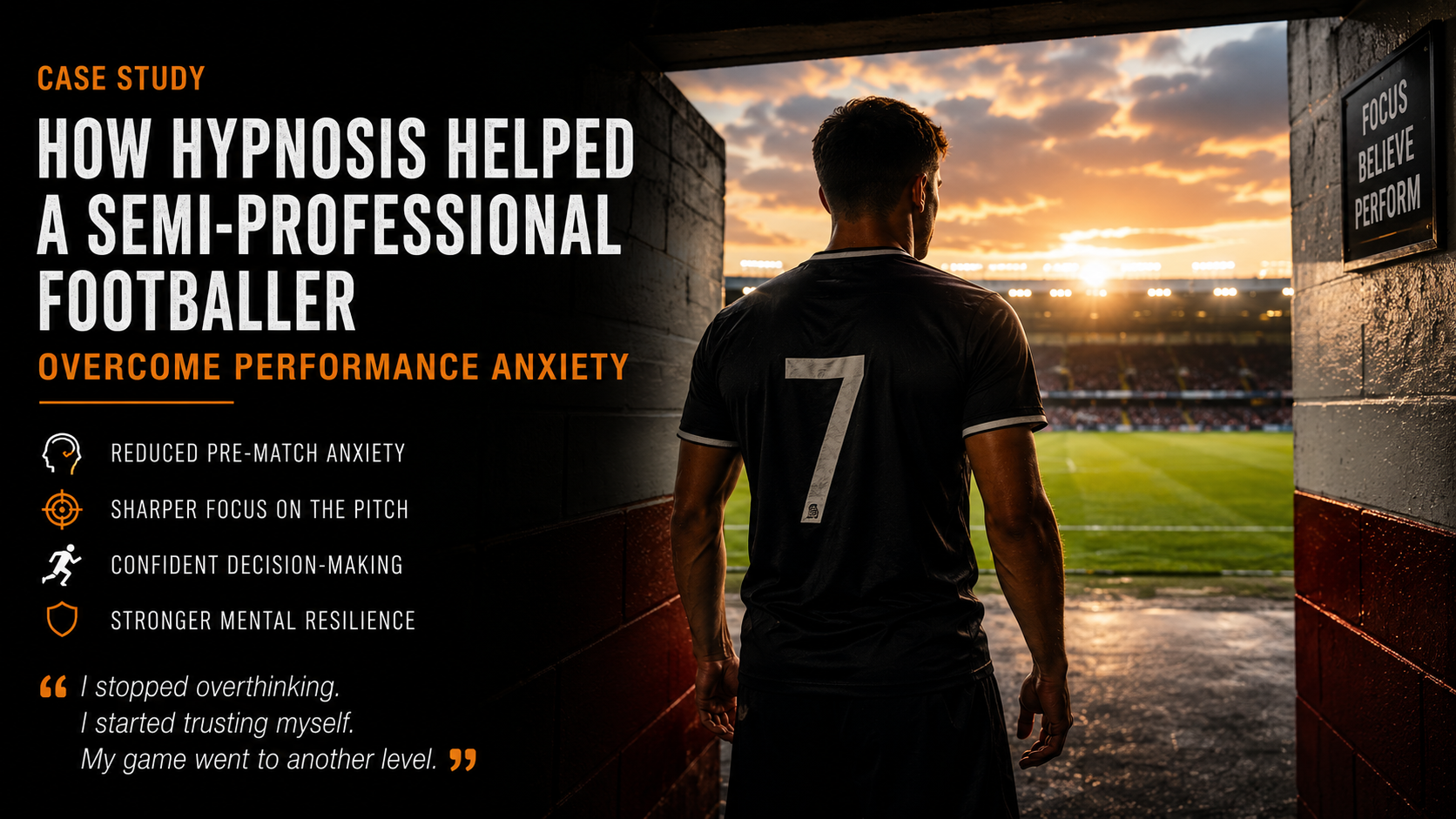
How Hypnosis Helped a Semi-Professional Footballer Overcome Performance Anxiety
Background: A Footballer Struggling With Matchday Performance Anxiety
I first worked with a 21-year-old semi-professional winger who came to me because he had reached a frustrating point in his football.
There was no question about his physical ability. He was quick, technically very good, capable of taking players on and had developed into an accomplished attacking player. Yet there was a significant difference between the player I saw in training and the player who appeared when an important match began.
In training, he was instinctive. He would receive the ball, attack defenders, make runs and cross without appearing to think about what he was doing.
On matchday, however, something changed.
He would begin experiencing considerable anxiety before the game. He described feeling nauseous, having a racing mind and becoming increasingly aware of everything that could go wrong. Once the match started, this mental noise could follow him onto the pitch.
The biggest problem was that it affected his attacking decisions.
A winger often has only a fraction of a second to decide whether to take a defender on, pass, cross, cut inside or make another run. He was finding himself thinking about those decisions rather than simply making them.
He might receive the ball in an excellent attacking position and, instead of reacting instinctively, there would be a moment of hesitation.
By the time he had thought:
“Should I take him on?”
“What if I lose the ball?”
“Should I cross?”
the opportunity had sometimes disappeared.
What interested me was that he already possessed the skills he needed. My job wasn't to teach him how to play football. It was to help remove the mental interference that was getting between his ability and his performance.
His goal was therefore quite simple:
To arrive at matches feeling confident, trust his ability and make decisions automatically rather than allowing anxiety and overthinking to control his game.
Understanding His Performance Anxiety
Before beginning the hypnosis work, I wanted to understand what was happening inside his mind.
We explored what happened in the hours leading up to a match, what he said to himself, what he anticipated happening and, most importantly, what happened immediately before he began to feel anxious.
I discovered that his anxiety wasn't simply about playing badly.
There was a deeper fear of making the wrong decision and being judged because of it.
A missed cross could become:
“That was terrible.”
A defender winning a 1v1 could become:
“I should have beaten him.”
A poor pass could become:
“I'm not playing well today.”
The individual mistake was therefore acquiring far more significance than it deserved.
I explained to him that one of the things we would work on was changing the meaning he attached to these moments.
A mistake would become something that had happened—not something that defined him.
I also wanted him to understand that the physical symptoms he experienced weren't necessarily his enemy.
The racing heart, increased energy and heightened awareness could be interpreted as his body preparing him to perform.
Rather than:
“I'm anxious because something is going to go wrong.”
we began moving towards:
“My body is giving me the energy I need to perform.”
That became an important part of our work.
My Hypnotherapy Approach
Session One: Identifying the Triggers
The first session was largely about understanding his internal dialogue.
I asked him to take me through a typical matchday from waking up until the final whistle.
We identified the moments when his thoughts started to change.
I was particularly interested in the language he used internally.
There were recurring themes:
“I need to play well today.”
“I can't afford to make mistakes.”
“I need to prove myself.”
“What if I don't perform?”
I explained that when an athlete becomes focused on proving themselves, attention can move away from the task itself.
Instead of seeing the defender, the space and the opportunity, part of the mind is watching the player.
How am I doing?
Did that look good?
What will the coach think?
What will my teammates think?
That internal commentary was exactly what we wanted to reduce.
I wanted him to move from self-evaluation to external focus.
In other words:
Stop watching yourself perform and start performing.
Session Two: Creating a State of Calm and Control
In the second session, I introduced hypnosis more deeply.
I guided him through progressive relaxation, gradually allowing the muscles throughout his body to relax while his attention became increasingly focused.
Once he was deeply relaxed, I introduced what I call a safe-place anchor.
I asked him to imagine somewhere where he naturally felt completely comfortable and at ease.
The details weren't important to me; what mattered was the feeling associated with the place.
I encouraged him to notice the surroundings, the temperature, the sounds and the sense of being completely comfortable.
Then I gradually linked that feeling of calm to a simple physical cue.
This gave us a psychological reference point he could return to whenever his mind became overloaded.
But I didn't want him to become relaxed in a way that made him passive.
The objective wasn't:
“Be completely calm.”
It was:
“Be calm enough to allow your ability to come through.”
That distinction is important in sport.
A footballer doesn't necessarily need to feel tranquil before a match. They need to feel ready.
Session Three: Going Back to the Beginning
In the third session, I used age-regression techniques to explore earlier experiences connected with performance, failure and fear of making mistakes.
The purpose wasn't to dwell on the past.
I wanted to understand where some of his emotional responses had originated and help him recognise that an old experience did not have to dictate how he performed today.
We explored an early performance experience in which making a mistake had become associated with embarrassment and disappointment.
I then helped him view that younger version of himself from the perspective of the athlete he had subsequently become.
He could recognise something important:
One mistake had never actually meant he wasn't good enough.
It had simply felt that way at the time.
I used this to create a separation between past emotional experiences and present-day performance.
The message was essentially:
You have learned, developed and grown since then. You are not that younger player standing in that moment anymore. You have years of experience, training and successful performances behind you.
This helped establish a new foundation for the future work.
Session Four: Creating His Matchday Mindset
The fourth session became the most performance-specific part of the process.
I used extensive future pacing and mental rehearsal.
I didn't simply ask him to imagine scoring a goal.
I wanted him to experience the entire sequence of a match.
I began with the build-up.
He imagined arriving at the ground.
He could hear the sounds around him, feel the atmosphere and notice the familiar surroundings.
He imagined getting changed, putting on his boots and walking towards the pitch.
Then I introduced the sensations that previously triggered his anxiety.
His heart rate beginning to increase.
That familiar feeling in his stomach.
Thoughts beginning to appear.
But this time, instead of interpreting those sensations as danger, I had him reinterpret them.
Energy.
Readiness.
Preparation.
His body was getting ready to perform.
I then took him onto the pitch.
The Imagery: Receiving the Ball and Attacking
One of the first scenarios I rehearsed involved him receiving the ball on the wing with a defender directly in front of him.
I wanted the imagery to be as sensory and realistic as possible.
He could see the pitch.
He could hear teammates calling.
He could feel his boots connecting with the ground.
He could feel the ball arriving at his foot.
And then I deliberately slowed the mental sequence down.
He sees the defender.
He notices the defender's body position.
He sees the space behind him.
And rather than thinking:
“What should I do?”
he simply reads the situation and trusts his trained response.
He takes the defender on.
One touch.
Acceleration.
Change of direction.
Space opens up.
He continues forward.
Then I would rehearse different outcomes.
Perhaps the defender commits too early and he goes around him.
Perhaps the defender doesn't commit and he passes inside.
Perhaps the cross is on.
Perhaps the opportunity isn't there and he retains possession.
The important part wasn't that he always made the "perfect" decision.
The important part was that he made a decision confidently and committed to it.
I wanted him to experience the feeling of:
See → decide → commit → play.
Rather than:
See → think → doubt → hesitate.
Imagery: Delivering the Perfect Cross
I then had him rehearse crossing situations.
He receives the ball.
He looks up.
He sees the movement of the striker.
He feels the timing.
He selects the area he wants to hit.
And then he delivers the ball.
I encouraged him to experience the physical sensation of making the movement naturally and automatically.
The emphasis was on trusting the training already stored in his body.
He didn't need to consciously calculate every element of the technique.
His job was to see the opportunity, make the decision and allow his training to take over.
Imagery: Performing in a high pressure 1v1
I then deliberately introduced more pressure.
He imagines receiving the ball late in the match.
The score is close.
The crowd is louder.
The defender knows he is going to attack.
This was exactly the type of situation in which his old pattern would have appeared.
So I rehearsed the new response.
He notices the increased energy.
He takes a breath.
He squeezes his left thumb and forefinger together.
That becomes his performance anchor.
As he does so, he reconnects with the feeling of certainty and focus we had developed during hypnosis.
Then he looks at the defender.
Not at himself.
Not at the coach.
Not at the consequences.
At the defender.
He reads the situation.
He commits.
And he plays.
Rehearsing Mistakes
I also considered it essential to rehearse failure.
This might seem counterintuitive, but I didn't want him to believe that confidence depended upon everything going perfectly.
So I had him imagine losing the ball.
A cross goes out of play.
He makes the wrong decision.
A defender tackles him.
Then I rehearsed what happened next.
Instead of dropping his head and beginning to analyse the mistake, he immediately resets.
One breath.
Physical anchor.
Eyes up.
Back into position.
Ready for the next opportunity.
The suggestion was:
The previous point is finished. The next opportunity is the only one that matters.
This helped build something more valuable than confidence based on success.
It helped develop confidence in his ability to recover.
Creating a Performance Anchor
The thumb-and-forefinger anchor became an important part of the work.
During hypnosis, I repeatedly associated the physical action of squeezing his left thumb and forefinger together with the internal state we were building:
certainty, focus, composure and readiness.
I then rehearsed it repeatedly within different football scenarios.
Before receiving the ball.
Before taking on a defender.
After making a mistake.
When feeling pressure.
When the match became intense.
The idea was not that the physical movement possessed some magical quality.
It was that we were creating a well-rehearsed cue for a mental state.
With repetition, the action became associated with the state he wanted to access.
The Results
The changes became noticeable over the following weeks.
One of the first things he reported was that the physical anxiety he had previously experienced before matches had reduced considerably.
By the third week, he told me that the pre-match nausea had disappeared.
That was significant because the nausea had previously become almost a signal to him that he was going to have a bad game.
Now he could experience the normal physiological excitement of competition without immediately interpreting it as anxiety.
The second change was on the pitch.
He began using his physical anchor when he noticed himself starting to overthink.
Rather than allowing his thoughts to build, he could interrupt the pattern.
Breathe. Anchor. Look. Decide. Play.
He described feeling that he was getting back to the player he knew he could be in training.
The third change was reflected in his performances.
Over his next four matches he contributed three assists and one goal.
Of course, I don't regard those statistics alone as proof that hypnosis caused the improvement. Football performance is influenced by many factors.
What mattered more to me was what he described happening internally.
He was making attacking decisions more quickly.
He was taking opportunities rather than hesitating.
And, importantly, when something went wrong, he was recovering rather than allowing one mistake to contaminate the next five minutes.
The Most Important Change: His relationship with mistakes
For me, the most significant outcome wasn't the goal or the three assists.
It was the change in his relationship with mistakes.
Previously, a mistake could trigger:
Mistake → self-criticism → anxiety → overthinking → hesitation.
We worked towards:
Mistake → recognise → reset → refocus → play.
That is a much more resilient performance pattern.
He didn't need to become an athlete who never experienced nerves or made mistakes.
Instead, he became more capable of performing despite them.
What I Took From This Work
This case reinforced something I have seen repeatedly when working with athletes.
Sometimes the athlete doesn't need more confidence in their ability.
They need to trust the ability they already possess.
This winger had spent years developing his football skills. His problem wasn't that he didn't know how to beat a defender or deliver a cross.
His problem was that, under pressure, his conscious mind was trying to take control of skills that had already become automatic.
The hypnosis and imagery gave us a way of changing that relationship.
We weren't trying to create an entirely different player.
We were helping him reconnect with the player who was already there.
The central message I wanted him to take onto the pitch was simple:
You don't have to prove anything. You have trained for this. See the opportunity, trust your instinct, commit to your decision and play.
For me, that is what a peak matchday mindset is about.
Not the absence of nerves.
Not the absence of mistakes.
And certainly not trying to force yourself to feel confident.
It is having enough trust in yourself that, when the important moment arrives, you stop thinking about performing and simply perform.
How Hypnosis Can Help Footballers Perform Under Pressure
Every footballer responds to pressure differently. For some, it may show up as anxiety before a match. For others, it can appear as overthinking, loss of confidence, difficulty concentrating or hesitation when an important opportunity arrives.
In my work with footballers, I use hypnosis alongside mental imagery, relaxation and performance rehearsal to help change the way an athlete responds to these situations.
The aim isn't to make a footballer immune to pressure or eliminate every nervous feeling. Some level of physical arousal is a natural part of competition and can actually be useful. The goal is to help the athlete interpret those sensations differently and learn to use that energy rather than allowing it to become anxiety.
Hypnosis can also help reinforce the connection between what an athlete has practised and how they perform when the pressure increases. Through mental rehearsal, I can help a footballer repeatedly experience themselves making confident decisions, trusting their instincts and responding positively when something doesn't go according to plan.
For a winger, that might mean receiving the ball with a defender in front of them and instinctively recognising the opportunity. For another player, it might mean taking a penalty, making a crucial tackle, receiving the ball in front of a large crowd or recovering immediately after making a mistake.
The common theme is trust.
The athlete has already developed the physical skills through training. My role is to help reduce the mental interference that can prevent those skills from being expressed naturally in competition.
Ultimately, I want the player to move away from:
“I have to prove myself.”
and towards:
“I've prepared for this. I trust myself. Now I can play.”
Ready to Perform With Greater Confidence?
If you are a footballer who performs well in training but struggles with anxiety, self-doubt or overthinking when the pressure of competition increases, you don't necessarily need to change your ability.
You may need to change the way your mind responds when it matters most.
I work with athletes to help develop greater confidence, focus and trust in their ability to perform under pressure. Through sports hypnosis, mental imagery and performance-focused techniques, we can work on the mental patterns that may be interfering with your performance.
Whether you are struggling with pre-match anxiety, hesitation in important moments, loss of confidence after mistakes or simply finding it difficult to reproduce your training performance in competition, these are areas we can explore together.
If you would like to discuss how I could help you, get in touch with me.