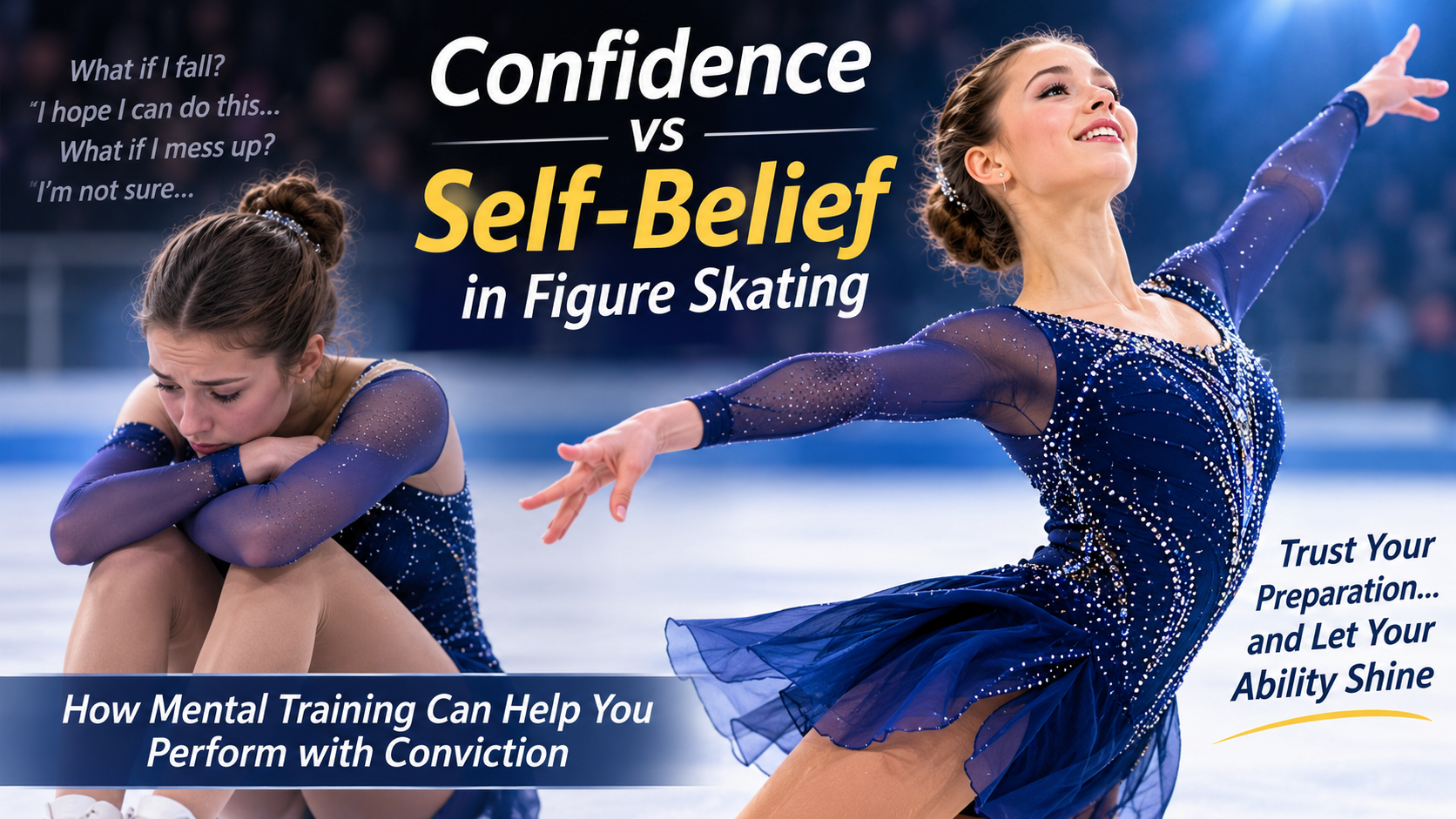
There is an interesting situation I sometimes encounter when working with athletes, particularly those competing at a high level. They possess the physical ability, technical skills and preparation to perform exceptionally well, and yet their competition performances don't always reflect what they are capable of achieving.
Figure skating provides a particularly good example.
Consider an athlete who regularly performs well in her short programme. She demonstrates excellent technical ability, executes her elements and shows that she can compete under pressure. However, when it comes to her longer programme, the performance doesn't always reach the same standard. In practice, she can skate beautifully, although, like any athlete, she also has days when things don't quite come together.
Her coaches know what she can do. They see it in training. They know she has the ability to execute the required elements. Their frustration is understandable when they see an athlete repeatedly fall short of what they know she can achieve.
Their observation that she needs to demonstrate more attitude towards herself rather than appearing timid raises an important psychological question:
If an athlete has the ability, why doesn't she always allow herself to demonstrate it?
The answer may have very little to do with technical ability.
The Difference Between Confidence and Self-Belief
Although confidence and self-belief are often used interchangeably, I see an important distinction between the two.
Confidence can be influenced by circumstances. An athlete may feel confident after a particularly good training session, a successful competition or receiving positive feedback from a coach. Equally, a difficult practice, a missed jump or a disappointing performance can temporarily undermine that confidence.
Confidence can fluctuate.
Self-belief, however, needs to run deeper.
Self-belief is the underlying acceptance that you possess the ability, that you have put in the work, and that you can trust yourself to perform even when circumstances aren't perfect.
It isn't dependent on having a good day in practice. It isn't dependent on everything feeling right or every jump being executed perfectly.
It is the ability to recognise that an occasional mistake doesn't diminish your ability, and that one difficult training session doesn't suddenly take away everything you have worked towards.
An athlete with strong self-belief doesn't necessarily feel confident every moment. What they have developed is the ability to continue believing in themselves when confidence temporarily wavers.
This distinction is particularly important in a sport where performances are judged on execution, consistency, presentation and technical precision.
Why the Longer Programme Can Present a Different Challenge
A short programme and a longer programme place different demands on an athlete.
The longer programme requires sustained concentration, physical endurance, emotional control and the ability to maintain commitment throughout the performance.
There are more opportunities for things to go wrong, but there are also more opportunities to demonstrate ability.
An athlete who performs well in the short programme may approach the longer programme with a different mindset. Perhaps there is greater anticipation, more awareness of the technical demands, or an increased expectation that she must deliver another good performance.
Sometimes, without consciously recognising it, an athlete begins to think about what might happen rather than concentrating on what she is actually doing.
She may start anticipating the next jump, questioning whether she will execute it correctly or becoming overly conscious of the consequences of making a mistake.
This can create a subtle shift.
Instead of allowing the body to execute movements that have been practised repeatedly, the athlete begins trying to control the performance through conscious thought.
In a sport requiring timing, rhythm, coordination and fluid movement, excessive conscious control can interfere with natural execution.
The athlete hasn't lost her ability. She may simply be getting in the way of it.
This is not necessarily what is happening with every skater who struggles in a longer programme, but it is an important possibility to explore.
The Problem With Trying Too Hard to Be Perfect
One of the difficulties I see in athletes is the tendency to associate a successful performance with the absence of mistakes.
Naturally, every athlete wants to skate cleanly. However, when the desire to avoid mistakes becomes too prominent, it can create a restrictive mindset.
The athlete becomes more concerned with not getting something wrong than with allowing herself to perform what she has trained to do.
There is a considerable psychological difference between these two approaches.
One is driven by avoiding failure.
The other is driven by expressing ability.
When an athlete is overly concerned about mistakes, she can become hesitant, cautious and less committed to her movements. This may be what coaches interpret as timidity or a lack of attitude.
But telling an athlete to have more confidence or to be less timid doesn't necessarily provide her with the psychological tools to make that change.
She needs to develop a different relationship with her own ability.
What Does Having More Attitude Actually Mean?
I think this is an important point.
When coaches say an athlete needs more attitude, they aren't necessarily asking her to become a different person. They may be asking her to demonstrate greater ownership of her performance.
That means skating with conviction rather than hesitation.
It means approaching each element with the expectation that she belongs on the ice and has every right to execute the skills she has spent countless hours developing.
It means trusting her preparation rather than continually questioning it.
And perhaps most importantly, it means allowing herself to perform without constantly evaluating how she is doing.
There is a difference between being timid and being composed. An athlete doesn't need to become loud, aggressive or outwardly dominant to demonstrate strength.
Quiet determination can be every bit as powerful.
The objective is to develop an internal attitude that says:
I have done the work. I know what I am capable of. I don't need to prove my ability to myself with every movement. I can trust what I have learned and allow myself to perform.
The Solution: Developing Self-Belief Through Mental Training
This is where I believe mental training can make a significant difference.
My approach to sports performance hypnosis is not simply about telling an athlete to be confident or repeating positive statements.
It is about helping the athlete develop a stronger internal understanding of her ability and changing the thought patterns and emotional responses that may interfere with performance.
There are several areas I would explore.
1. Separating performance from personal judgement
An athlete needs to understand that a difficult training session doesn't define her ability.
A missed jump is an event, not an identity. An off day is an off day, not evidence that she cannot perform.
Learning to separate temporary performance fluctuations from her underlying ability is an important part of developing resilience.
2. Building trust in preparation
She has spent countless hours developing her technical skills. Those skills haven't suddenly disappeared because a particular session didn't go well.
Mental training can help reinforce the connection between preparation and performance, allowing her to place greater trust in what her body already knows how to do.
3. Mental rehearsal of the complete programme
I particularly like using mental rehearsal to help athletes experience successful performances internally.
Rather than concentrating exclusively on individual jumps or technical elements, I would encourage her to mentally experience the entire programme.
Feeling the opening movement, establishing rhythm, committing to each element and maintaining composure through to the final moments.
The objective is to develop a familiar internal experience of performing with freedom, conviction and control.
This is especially valuable for the longer programme, where maintaining the same commitment and concentration throughout is important.
4. Developing a stronger performance identity
I would also work on how she sees herself as an athlete.
Does she see herself as someone who is capable of delivering a complete, confident performance, or does she identify more strongly with the possibility of making mistakes?
The language we use internally matters.
The objective is to develop an identity based on ability, preparation, commitment and self-trust rather than uncertainty and fear of failure.
5. Learning to perform rather than monitor
Finally, I would work towards reducing the tendency to continually evaluate performance while it is happening.
The athlete needs to be present in the programme, responding to the music, movements and transitions rather than mentally judging every element.
There is a time for technical analysis and correction. That time is practice, with the coaches providing feedback.
Competition is the time to allow that preparation to come together.
Hypnosis: Helping the Athlete Trust What She Already Knows
One of the advantages of sports performance hypnosis is that it provides an opportunity to work with the athlete's internal responses at a deeper level.
Through carefully structured mental rehearsal and positive psychological conditioning, I work towards helping athletes develop a stronger sense of self-belief, emotional composure and trust in their abilities.
For a figure skater, this might involve mentally experiencing the complete programme with a sense of freedom, commitment and enjoyment.
It also involves developing the ability to respond constructively to occasional setbacks, rather than allowing one difficult practice or an imperfect element to influence the next performance.
I don't want an athlete to become dependent on having everything feel perfect before she believes in herself.
I want her to recognise that she can perform even when she experiences some uncertainty.
That is an important difference.
The Objective Is Not to Create a Different Athlete
Ultimately, I don't believe this type of athlete necessarily needs more technical instruction or to be told repeatedly how talented she is.
She needs to develop greater trust in the talent and ability she already possesses.
Her coaches can see it. She demonstrates it in practice. The challenge is helping her access that same ability consistently when she competes.
Confidence may come and go. Training sessions may be excellent one day and frustrating the next. That is part of being an athlete.
But self-belief provides something more dependable.
It allows an athlete to step onto the ice without needing reassurance that everything will go perfectly.
She knows she has prepared. She knows she has the ability. She accepts that no performance is entirely predictable, but that doesn't diminish her belief in herself.
The ultimate objective is to move from thinking, 'I hope I can do this,' to knowing, 'I have prepared for this, I am capable of doing this, and I am going to allow myself to perform.'
Because sometimes the biggest obstacle standing between an athlete and the performance she is capable of producing isn't a lack of ability.
It is learning to trust herself enough to let that ability show.